
Kedarnath Temple: History, Jyotirlinga Story, Spiritual Significance & Complete Yatra Guide
Discover Kedarnath Temple’s history, Pandava legend, Jyotirlinga meaning, rituals, 2026 opening information, trek route and practical pilgrimage guidance.

What you will discover
- Why Kedarnath is revered simultaneously as a Jyotirlinga, a Panch Kedar shrine and part of Uttarakhand’s Char Dham circuit.
- How the Pandava story, the form of the sacred lingam and the Himalayan landscape are woven together in living tradition.
- What historians and official temple sources say about the present stone structure and Adi Shankaracharya’s association with it.
- How to plan the Gaurikund–Kedarnath trek, registration, weather preparation and a respectful pilgrimage in 2026.
- How devotees who cannot travel can still hold a sincere Sankalp and participate in worship without confusing faith with a travel transaction.
Long before Kedarnath Temple appears, the journey begins to change. Roads narrow beside the Mandakini. Pine-covered slopes rise into bare rock. The air becomes thinner, conversations quieter, and every bend seems to ask the traveller to leave something unnecessary behind. Then, after the final ascent, the stone temple stands beneath an immense wall of snow. It is not the largest temple in India. It does not need to be. The mountains around it provide the scale, and the silence provides the sermon.
For millions of devotees, Kedarnath is where Lord Shiva is not merely remembered but encountered—as stillness, endurance and compassionate release. Pilgrims call the deity Baba Kedar with the intimacy reserved for one who is both cosmic and close. The shrine is one of the twelve Jyotirlingas, part of the Panch Kedar tradition and one of the four sacred destinations in Uttarakhand’s Char Dham Yatra. Few temples sit at the meeting point of so many living sacred geographies.
Yet Kedarnath is also a physical pilgrimage at high altitude, governed by weather, terrain and seasonal access. A meaningful guide must therefore hold two truths together: the timeless world of sacred story and the changing world of routes, registration, health and administration. This article treats traditional narratives with reverence while identifying them as tradition, and uses official sources for practical details that a traveller should verify again before departure.
Why Kedarnath calls the heart
Every pilgrimage has an outer route and an inner route. The outer route to Kedarnath passes through Rishikesh, Rudraprayag, Guptkashi, Sonprayag and Gaurikund before becoming a mountain trail. The inner route is less visible. It may begin with grief, gratitude, a promise made for one’s parents, a prayer for a child, a desire for forgiveness or simply a longing that has no convenient name. By the time the pilgrim reaches the temple, these private reasons have travelled through rain, fatigue, cold and uncertainty. The prayer has acquired weight.
Shiva in Kedarnath is worshipped in a form unlike the smooth cylindrical lingam familiar in many temples. The sacred form is an irregular, conical rock associated in tradition with the hump of Shiva’s buffalo form. One does not stand before a polished symbol of perfection. One stands before a form that seems to rise directly from the mountain itself. This is central to Kedarnath’s spiritual power: the boundary between temple, deity and landscape feels unusually thin.
Kedarnath does not promise that the mountain will become easy. It teaches the pilgrim that the heart can become steady.
Mandir Vedas reflection
Kedarnath Temple quick facts
| Question | Answer |
|---|---|
| Where is Kedarnath Temple? | Rudraprayag district, Garhwal Himalayas, Uttarakhand |
| Which deity is worshipped? | Lord Shiva in the form of Kedarnath or Sadashiva |
| Why is it especially sacred? | One of the twelve Jyotirlingas; also part of Panch Kedar and Uttarakhand Char Dham |
| Approximate altitude | About 3,580 metres above sea level |
| Road access ends at | Gaurikund, reached via Sonprayag transport arrangements |
| Standard trekking distance | Approximately 16 km from Gaurikund |
| 2026 opening date | 22 April 2026, as listed by the official Uttarakhand registration portal |
| Winter worship | The deity’s winter worship is associated with Omkareshwar Temple at Ukhimath |
| Official registration | Tourist Care Uttarakhand Char Dham registration portal |
The Kedarnath story: the Pandavas, Shiva and the buffalo form
The best-known sacred narrative of Kedarnath begins after the Mahabharata war. The Pandavas had won a kingdom, but victory could not quiet the moral burden of a war in which relatives, teachers and countless warriors had died. According to temple tradition, they sought Lord Shiva so that they might atone for the violence and receive his grace. Shiva, unwilling to grant them an easy absolution, withdrew into the Himalayas. The search itself became part of their penance.
At Guptkashi—whose name evokes the hidden Kashi—the Pandavas are said to have come close to Shiva, but the Lord concealed himself again. He assumed the form of a buffalo and mingled with a herd. Bhima, the strongest of the brothers, recognised that one animal carried an extraordinary presence. In a popular telling, he stood astride the valley so that the herd had to pass beneath him. The disguised Shiva attempted to disappear into the earth, but Bhima reached for him.
The divine buffalo’s form then manifested across five Himalayan places. The hump appeared at Kedarnath, the arms at Tungnath, the face at Rudranath, the middle or navel region at Madhmaheshwar, and the matted hair at Kalpeshwar. Together, these shrines are worshipped as the Panch Kedar. Uttarakhand Tourism presents this sequence as a living regional tradition, while individual retellings vary in detail. What remains constant is the moral centre of the story: the Pandavas could not escape responsibility merely because their cause had been declared righteous.
Shiva’s initial refusal is spiritually significant. Forgiveness is not portrayed as a shortcut around remorse. The brothers must search, endure and become inwardly prepared. When grace finally arrives, it does not erase the past; it transforms their relationship with it. Kedarnath therefore speaks powerfully to anyone carrying regret. The shrine is not only a destination for asking that difficulties be removed. It is a place for asking to see truth without running from it.
Why Kedarnath is a Jyotirlinga
The Sanskrit word Jyotirlinga joins jyoti, meaning light or radiance, with linga, the sign through which Shiva is known. In devotional understanding, a Jyotirlinga is not simply a famous stone emblem. It points toward Shiva as immeasurable consciousness—the column of light without a discoverable beginning or end. The twelve Jyotirlinga shrines are revered as places where this boundless presence is especially remembered and worshipped.
Kedarnath is often described as the highest of the twelve Jyotirlingas by altitude. The physical setting makes the symbolism immediate. Human structures appear small beneath the peaks; weather can reorganise every plan; even breathing demands attention. The pilgrim encounters limits everywhere. Against those limits, the idea of jyoti—the unbounded light of Shiva—becomes more than philosophy. It becomes a felt contrast between the fragile traveller and the vastness in which the traveller exists.
The Jyotirlinga and Panch Kedar identities do not compete. They illuminate different dimensions of the same shrine. The Jyotirlinga tradition places Kedarnath within a pan-Indian network of Shiva worship. The Panch Kedar story places it within the intimate topography of Garhwal, where different aspects of Shiva are approached through separate valleys and demanding routes. Char Dham situates it within a pilgrimage movement that also honours Yamuna, Ganga and Vishnu. Kedarnath is local and universal at once.
Kedarnath Temple history and architecture
Official district and temple sources associate the original sacred site with the Pandavas and the present temple with Adi Shankaracharya, traditionally dated to around the eighth century. Uttarakhand Tourism describes the existing structure as more than twelve centuries old, while the Shri Badarinath Kedarnath Temple Committee explains that it stands near the location of an earlier Pandava shrine. Precise dating of ancient Himalayan temples is complex, so responsible writing should avoid turning belief, institutional tradition and archaeological certainty into the same category.
What can be seen is remarkable enough. The temple rises on a broad rectangular platform and is built from massive, carefully cut grey stone slabs. A mandapa provides an assembly space before the garbhagriha, the innermost sanctum. The approach is guarded by Nandi, Shiva’s bull and devoted attendant, facing the temple door. Official descriptions note figures of deities and mythological scenes on inner surfaces, as well as inscriptions associated with the stone steps.
The architecture feels inseparable from survival. This is a high-altitude environment of snow, intense rain, freeze-thaw cycles and seismic forces. The walls do not seek delicacy; they communicate mass, proportion and rootedness. Unlike temples whose ornament dominates the first impression, Kedarnath’s beauty comes from the dialogue between austere stone and overwhelming landscape. The tower rises, but the mountains rise farther. The temple appears not to conquer nature but to belong to it.
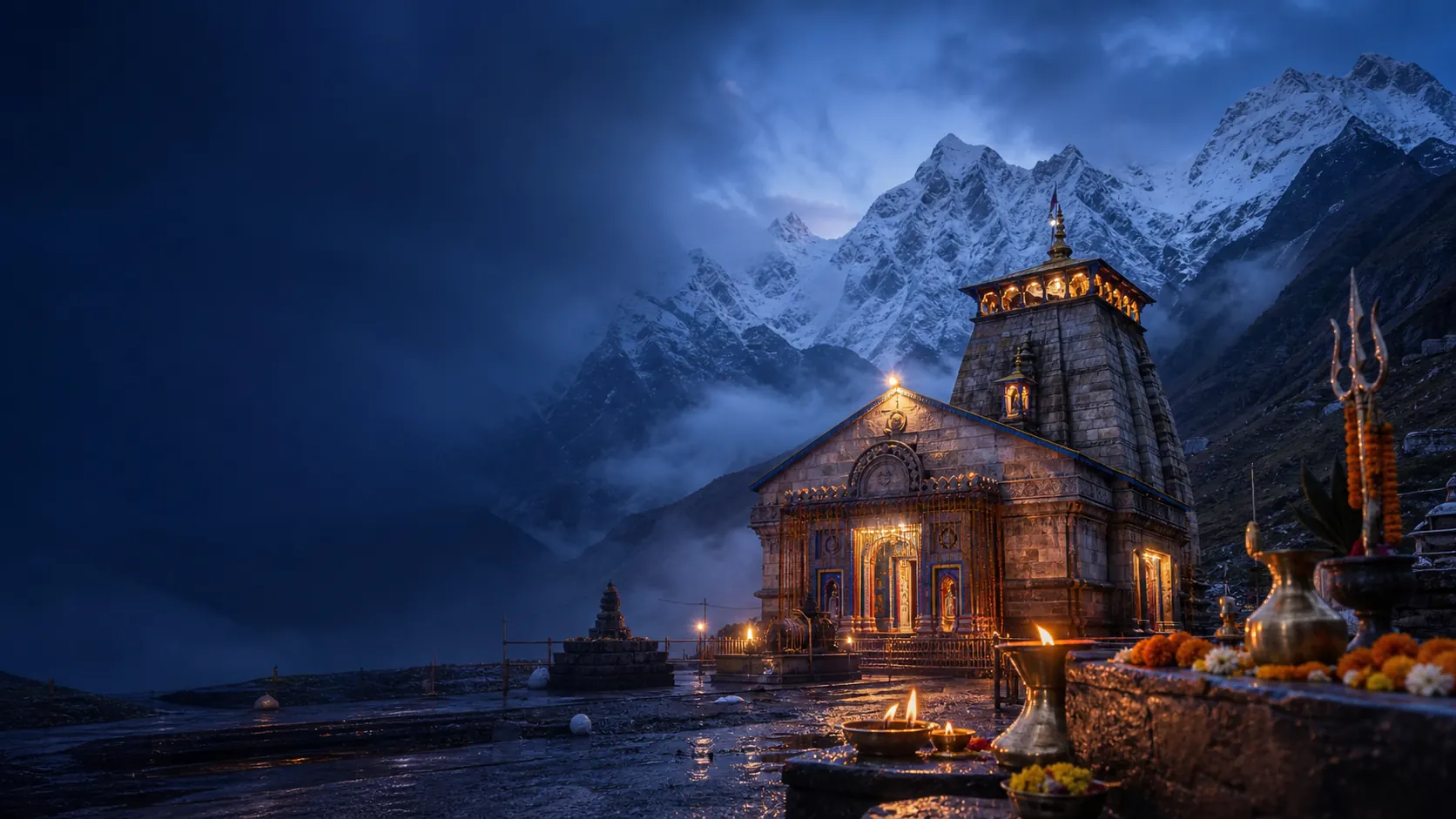
Adi Shankaracharya’s association adds another layer to the shrine’s place in Indian religious memory. Tradition credits the philosopher-saint with renewing important pilgrimage centres and articulating a vision of spiritual unity across the subcontinent. A samadhi shrine associated with him is located behind Kedarnath Temple. Whether a pilgrim approaches through Advaita philosophy or simple devotion to Shiva, the site evokes a movement beyond the narrow self toward a larger reality.
The 2013 floods and the meaning of Bhim Shila
In June 2013, catastrophic flooding and debris flows devastated Kedarnath town and large parts of Uttarakhand. Lives were lost, buildings disappeared and the geography of the settlement was violently altered. The temple itself remained standing. Behind it, a huge boulder came to rest, and the flow of debris was diverted around the shrine. Today this rock is widely known as Bhim Shila and is approached by many pilgrims with reverence.
Uttarakhand Tourism records the local belief that the boulder protected the temple by redirecting floodwaters. Devotional language may call this grace; geological language may describe the movement and final position of the rock. These need not be forced into an argument. Pilgrimage landscapes often hold natural process and sacred meaning together. For survivors and devotees, Bhim Shila became a visible symbol of protection in the middle of unimaginable loss.
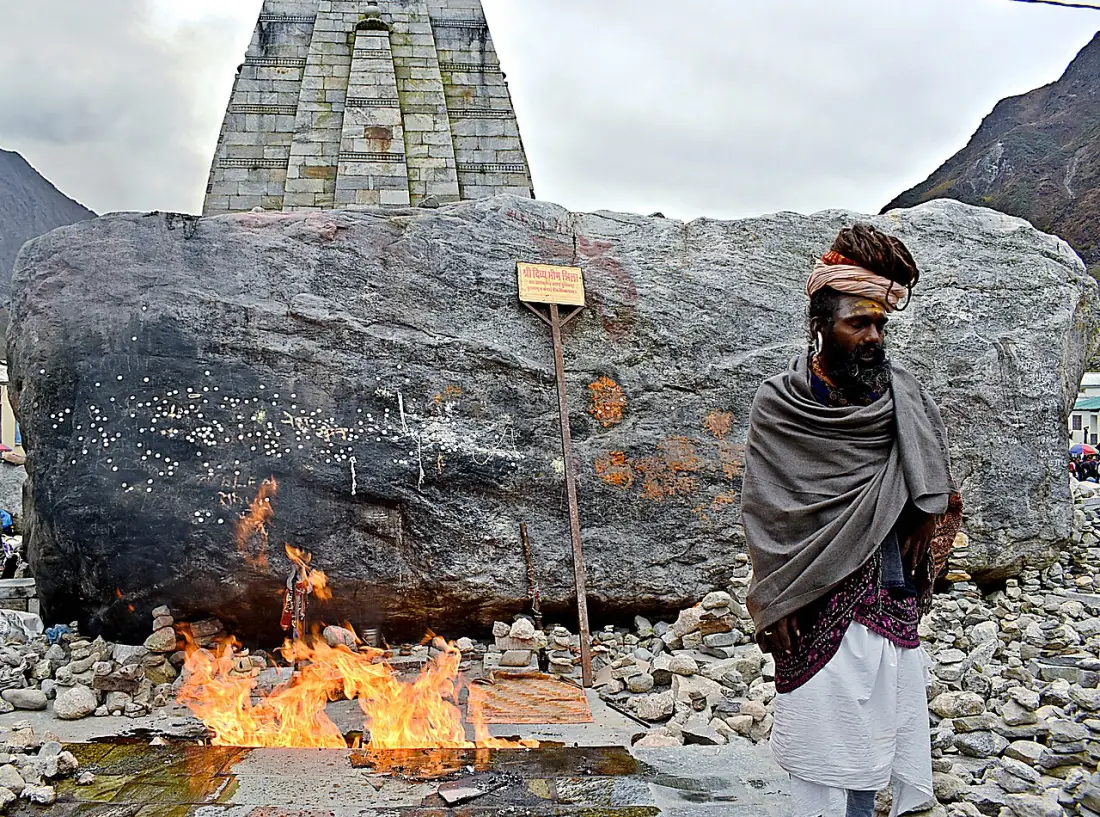 Real photograph
The deeper lesson is not that sacred places are exempt from suffering. The surrounding devastation makes that interpretation impossible. Rather, Kedarnath became a place where grief, rebuilding and faith had to coexist. A respectful visitor should remember that the beautiful rebuilt pathways stand on ground marked by loss. Silence near Bhim Shila can be an act of remembrance as much as an act of worship.
Darshan, worship and what a pilgrim experiences
Darshan literally involves seeing, but in temple practice it is reciprocal: the devotee beholds the deity and understands that the divine also beholds the devotee. At Kedarnath, the moment may be brief because of crowds, weather or administrative movement. Its depth does not depend on duration. A pilgrim who has walked for hours may reach the sanctum with an entire family’s prayers condensed into a few seconds.
Traditional worship can include offerings, abhishek, recitation, archana and the taking of a Sankalp. A Sankalp is a conscious statement of sacred intention, often including the devotee’s name, family lineage or gotra and the purpose of the prayer. It is not a magical contract that compels a result. At its best, it gathers a scattered mind and places one’s intention before the deity with humility. The value lies in sincerity, right conduct and remembrance—not in the size of an offering.
Temple services, permitted forms of worship and booking arrangements are governed by the official temple committee and can change. Pilgrims should use the Shri Badarinath Kedarnath Temple Committee for official puja and donation services. Mandir Vedas is an independent devotional service and does not claim to represent the temple administration. This distinction protects the devotee from confusion and honours the authority of the institution responsible for the shrine.
- Before entering, slow your breathing and decide the one prayer you most need to carry into the sanctum.
- Keep phones and conversation secondary to the sacred atmosphere and follow all local photography restrictions.
- Do not push for a longer darshan when queues are heavy; another pilgrim’s longing is as real as your own.
- If giving donations or booking official worship, use authorised counters or the official temple committee platform.
- Carry back the discipline of the pilgrimage—truthfulness, restraint and compassion—rather than treating darshan as the end of the journey.
When Kedarnath opens and where Baba Kedar is worshipped in winter
Because of extreme Himalayan winter, Kedarnath Temple is open only for part of the year. The shrine generally opens in spring and closes in autumn, with ceremonial dates determined according to the religious calendar and announced by the relevant authorities. For the 2026 season, the official Uttarakhand Char Dham registration portal lists 22 April 2026 as the opening date. Travellers should never rely on an old article for the closing date or daily timings.
When the high-altitude shrine closes, worship continues at Omkareshwar Temple in Ukhimath, regarded as the winter seat of Kedarnath. This seasonal movement expresses something beautiful: a temple door may close because of snow, but worship does not stop. The deity’s presence accompanies the community to a place where ritual life can continue safely. Devotees travelling outside the main season may therefore consider visiting Ukhimath with the same reverence.
How to reach Kedarnath: the journey before the trek
Most road journeys toward Kedarnath begin from Haridwar or Rishikesh and continue through Devprayag or Srinagar, Rudraprayag, Agastyamuni, Guptkashi and Sonprayag. Exact routing can change with road conditions. Sonprayag functions as an important transport and control point, and onward local arrangements lead toward Gaurikund, the traditional base of the trek. Private vehicles may face regulated movement, parking restrictions or transfers, especially during peak pilgrimage periods.
The nearest major rail approach is commonly taken through Rishikesh or Haridwar, while Jolly Grant Airport near Dehradun serves air travellers. The temple committee’s destination information places Rishikesh more than two hundred kilometres from Kedarnath and Jolly Grant farther away by road. Mountain distance should never be converted into plains driving time. Landslides, pilgrim traffic, road works and weather can turn a short-looking section on a map into many hours.
- Complete the mandatory Char Dham registration through the official Tourist Care Uttarakhand system and keep the registration letter or QR details available.
- Plan a buffer day in the lower altitude region rather than building an itinerary with no room for weather or fatigue.
- Confirm local transport arrangements between Sonprayag and Gaurikund close to your travel date.
- Begin the trek early and obey official movement windows, route closures and safety instructions.
- Keep a return plan flexible; the mountain, not the itinerary, has the final word.
Helicopter services operate seasonally from designated locations such as Phata, Sirsi and Guptkashi, subject to weather and official arrangements. They reduce walking but do not remove altitude risk. Sudden ascent can be physically demanding, and flights may be delayed or cancelled. Never buy helicopter tickets from unofficial agents or links circulated through unsolicited messages. Fraud around pilgrimage bookings is itself a reason to begin from official portals.
The Gaurikund to Kedarnath trek: 16 kilometres of patience
Official tourism information describes the standard trek from Gaurikund to Kedarnath as approximately sixteen kilometres. The route is often classified as medium to steep, but difficulty is personal. Someone comfortable at sea level may still struggle as altitude rises. Rain can change footing, ponies can make narrow sections crowded, and the final kilometres may feel longer than the number suggests. The wisest pace is one that allows steady breathing and leaves enough strength for changing weather.
Walking is only one mode. Depending on current rules and availability, pilgrims may use registered ponies, palkis or other authorised support. Treat handlers and animals with respect. Confirm prices at official counters where available, avoid overloading, and do not create pressure for unsafe speed. A pilgrimage cannot be called sacred if convenience is purchased through another being’s suffering.
Gaurikund is itself sacred in local tradition. It is associated with Goddess Parvati’s tapasya to attain Shiva as her husband, and a temple dedicated to her stands in the area. Beginning at Gaurikund therefore gives the trek a symbolic movement: from Parvati’s patient devotion to Shiva’s austere presence. The path is not empty distance between parking and darshan. It is part of the liturgy of the journey.
| Carry | Why it matters |
|---|---|
| Layered warm clothing | Temperatures can change sharply, even when the lower valleys are warm |
| Water and simple energy food | Regular hydration and small amounts of food support a steady pace |
| Rain protection | Mountain rain can arrive quickly; protect yourself and essential documents |
| Supportive footwear | Uneven, wet and crowded sections require grip and stability |
| Personal medicines | Carry prescriptions in original packaging and discuss altitude with your clinician |
| Registration and identity documents | Required for verification and useful in emergencies |
| Small waste pouch | Bring non-biodegradable waste back to an appropriate disposal point |
| Power bank and torch | Useful during delays, though neither replaces an early start |
Health, altitude and safety: devotion is not a reason to ignore the body
Kedarnath stands at roughly 3,580 metres. At this height, reduced oxygen can affect people regardless of devotion, age or previous fitness. Headache, unusual fatigue, nausea, dizziness, poor coordination or breathlessness should not be treated as a test of faith. Stop, inform companions and seek trained medical support. Severe or worsening symptoms require descent and professional assessment. A clinician who knows your medical history is the right person to advise whether and how you should undertake the journey.
The official temple information specifically warns pilgrims about extreme cold, low humidity, stronger ultraviolet exposure and reduced air and oxygen pressure. People with heart, lung or other significant conditions should obtain medical advice before travelling. Even healthy pilgrims benefit from rest, hydration, gradual ascent and realistic planning. Alcohol, smoking and sedating substances can make an already demanding environment more dangerous.
Weather is a safety system, not background scenery. Heavy rain can trigger landslides and route closures; snow or cold can arrive outside a traveller’s expectations. Check official forecasts and local instructions each day. If authorities suspend movement, waiting is not a spiritual failure. The Shiva who is worshipped as consciousness cannot require a devotee to disregard clear danger merely to preserve a hotel booking or social-media plan.
Sacred places around Kedarnath worth understanding
Bhairavnath Temple
Bhairavnath is revered as the guardian of Kedarnath, especially during the winter period when the main shrine is closed. The temple stands above the settlement and requires an additional uphill walk. The view back toward Kedarnath can be extraordinary, but the visit should not be rushed into an already exhausting schedule. In sacred imagination, Bhairava represents fierce protection—the energy that guards a holy boundary and confronts carelessness.
Adi Shankaracharya Samadhi
Behind the main temple is the samadhi associated with Adi Shankaracharya. It invites a different quality of contemplation from the busy darshan line. Shankaracharya’s teaching points toward the non-dual reality in which the deepest self is not separate from absolute consciousness. Even a visitor unfamiliar with philosophy can sit quietly with a simple question: what remains when identity, achievement and anxiety are allowed to become still?
Vasuki Tal and Gandhi Sarovar
The high-altitude landscapes beyond Kedarnath include Vasuki Tal and Chorabari Lake, also known as Gandhi Sarovar. These are not casual add-ons to a temple visit. Conditions, permissions, route status, glacier terrain and personal fitness must be assessed locally. Uttarakhand Tourism notes that mountain weather changes abruptly. Travellers should use qualified guidance and never rely on an old online itinerary for remote routes.
Triyuginarayan, Guptkashi and Ukhimath
The wider region forms a network of Shiva and Shakti memory. Triyuginarayan is traditionally associated with the divine marriage of Shiva and Parvati. Guptkashi carries the story of Shiva’s concealment from the Pandavas. Ukhimath holds Kedarnath’s winter worship. Visiting these places can transform a rushed single-destination trip into a more coherent pilgrimage, where each stop adds a chapter to the story rather than another photograph to a checklist.
If you cannot travel: can a Sankalp still reach Kedarnath?
Not every devotee can undertake a high-altitude pilgrimage. Age, disability, health, caregiving, distance, finances or family duty may make the journey impossible. Hindu devotional life has never limited remembrance to physical proximity alone. A home altar, the repetition of Om Namah Shivaya, service performed in Shiva’s name and a sincere Sankalp can all become forms of approach. The mountain is sacred, but sincerity is not measured in kilometres.
Some families choose to have an archana or name-based prayer offered through a trusted local priest or devotional service. If using any independent service, clarity matters. Ask what will actually be performed, where it will occur, what evidence will be provided, how names and gotra details are handled and whether the service clearly distinguishes itself from the official temple administration. A sacred offering should never depend on misleading claims.
Mandir Vedas offers a personalised Kedarnath Archana in which submitted family names and gotra details form the Sankalp, followed by temple-premises video proof sent on WhatsApp. It is an independent devotional service, not an official arm of the temple committee. For devotees who cannot travel, the purpose is not to imitate every part of physical darshan. It is to create a truthful, personal bridge of prayer—one that lets a family hear its names carried with reverence in the presence of Baba Kedar.
The real return journey from Kedarnath
A pilgrimage is incomplete if the traveller returns with photographs but no change in conduct. Kedarnath’s lessons are severe and tender. The Pandavas teach that success does not cancel responsibility. The hidden Shiva teaches that the divine cannot be captured by demand. The stone temple teaches steadiness. Bhim Shila teaches remembrance in the shadow of disaster. The winter journey to Ukhimath teaches that sacred presence can move without disappearing.
When pilgrims descend toward Gaurikund, the temple becomes smaller behind them until the path turns and it vanishes. This disappearance is part of the teaching. Kedarnath cannot remain only an object in front of the eyes. It must become a quality carried within: the courage to face what is true, the humility to accept limits, and the quiet strength to keep one’s heart open in difficult terrain.
Perhaps this is why Baba Kedar continues to call people across generations. The call is not always an instruction to travel immediately. Sometimes it is an invitation to begin preparing. Sometimes it is a reminder to fulfil an old promise. Sometimes it is simply the sound of Om Namah Shivaya arising in a life that has become too noisy. Wherever the call meets you, receive it with patience. The mountain has waited for centuries. A sincere step is already part of the journey.
Frequently asked questions
Why is Kedarnath Temple famous?+
Kedarnath is revered as one of the twelve Jyotirlingas of Lord Shiva, the foremost shrine of the Panch Kedar tradition and one of the four destinations in Uttarakhand’s Char Dham Yatra. Its high Himalayan setting, Pandava legend and ancient stone architecture give it exceptional spiritual and cultural importance.
Is Kedarnath one of the twelve Jyotirlingas?+
Yes. Kedarnath is traditionally counted among the twelve Jyotirlingas and is often described as the highest of them by altitude.
Who built Kedarnath Temple?+
Sacred tradition associates an original shrine with the Pandavas. Official temple and tourism sources associate the present structure or its establishment with Adi Shankaracharya around the eighth century. These statements combine living tradition with institutional historical understanding; exact archaeological dating is more complex.
What is the Kedarnath Temple opening date in 2026?+
The official Tourist Care Uttarakhand portal lists 22 April 2026 as the opening date for the 2026 season. Dates, timings and access conditions can change, so verify them again on official portals before travelling.
How long is the Kedarnath trek?+
The standard route from Gaurikund to Kedarnath is approximately 16 kilometres according to official Uttarakhand tourism information. Time and difficulty vary with fitness, altitude, weather and crowd conditions.
Can senior citizens visit Kedarnath?+
Some senior citizens do visit, but age alone does not determine safety. Kedarnath is a high-altitude journey involving cold, reduced oxygen and potentially strenuous movement. A qualified medical professional should assess individual health, and travellers must follow current official advisories.
Where is Kedarnath worshipped during winter?+
During the winter closure of the high-altitude shrine, worship associated with Kedarnath continues at Omkareshwar Temple in Ukhimath, which is regarded as the winter seat of Baba Kedar.
Is Char Dham registration required for Kedarnath?+
The official Uttarakhand registration portal states that registration and destination verification are required for the Char Dham and Hemkund Sahib Yatra. Complete the process through Tourist Care Uttarakhand and check for current instructions.
Can I book a puja if I cannot travel to Kedarnath?+
Yes, devotees may arrange worship through official temple services or an independent devotional service. Verify who provides the service, what is included and whether it clearly explains its relationship to the temple administration. Mandir Vedas offers an independent personalised Archana with submitted names and temple-premises video proof.
What mantra can I chant for Kedarnath?+
Om Namah Shivaya is the most widely accessible Shiva mantra. Chant it slowly and respectfully, focusing on remembrance rather than a fixed number. Devotees may also listen to or recite traditional Shiva prayers according to their family practice and guidance.
Sources and further reading
Travel requirements and temple schedules can change. These official sources were checked while preparing this guide.
- Shri Badarinath Kedarnath Temple Committee — Shri Kedarnath Dham
- Tourist Care Uttarakhand — official Kedarnath Dham information and 2026 opening date
- Tourist Care Uttarakhand — official Char Dham registration portal
- Uttarakhand Tourism — Kedarnath destination guide
- Uttarakhand Tourism — Panch Kedar tradition
- Uttarakhand Tourism — Char Dham circuit
- District Rudraprayag — district history and Kedarnath information
- Incredible India — Kedarnath overview