
Kedarnath Temple Architecture: Who Built It, How Old Is It and What the Stone Reveals
Explore Kedarnath temple architecture, history and builder traditions—what the stone, ASI conservation records and sacred memory actually reveal.
What you will discover
- The most honest answer to who built Kedarnath Temple—and why a precise construction date remains uncertain.
- A clear walk through the platform, mandapa, antarala, garbhagriha, tower, stone courses and Nandi approach.
- Which popular architecture claims are documented, traditional, plausible or still unproven.
- What Archaeological Survey of India records reveal about the temple after the 2013 disaster.
- Why Kedarnath is best understood as living heritage shaped by ritual, repair, weather and sacred geography.
Stand close to Kedarnath Temple and the first surprise is not its height. It is the weight of the wall. Individual grey blocks remain visible beneath darkened surfaces, painted cornices and bright ritual colour. Horizontal carved bands pass around the masonry like lines in a long memory. At the rear, the stone tower rises almost without distraction; at the front, Nandi waits before the doorway while bells, flowers, pilgrims and priests return the structure to the present tense.
Online, this extraordinary building becomes a collection of confident mysteries: the Pandavas built it in one night, every block locks without mortar, or it slept under ice for four centuries. Some statements preserve sacred memory; others are repeated far more confidently than the evidence allows.
Kedarnath does not become less sacred when we admit uncertainty. Once legend, institutional tradition, material evidence and conservation records are placed in their proper columns, the temple becomes more remarkable: a living structure carried through centuries of worship, repair, weather and human care.
The direct answer: what is Kedarnath Temple’s architecture, and who built it?
Kedarnath is a substantial stone Shiva temple raised on a broad rectangular platform in the upper Mandakini valley. Official descriptions identify massive, evenly dressed grey stone slabs, a garbhagriha or sanctum, an antarala or transitional chamber, a mandapa or assembly hall, and a tower rising over the sacred core. A large Nandi faces the entrance. Inside, an irregular conical rock is worshipped as Shiva in the form associated with Kedarnath.
Who built it? Sacred and institutional traditions give two connected answers. The Pandavas are remembered as founders of an earlier shrine after the Mahabharata war. The Shri Badarinath Kedarnath Temple Committee associates the standing temple with Jagadguru Adi Shankaracharya in the eighth century and places it beside the site of an earlier Pandava temple. These statements are important records of how the shrine remembers itself, but they do not amount to a complete archaeological construction history.
The surviving building has also been repaired and renewed many times. BKTC explicitly says the temple has been continually renovated over the centuries. ASI’s post-2013 work revealed donatory inscriptions and reused recovered architectural members—evidence of a monument with layers of patronage and intervention rather than a building untouched since one exact founding day. The honest historical answer is therefore: the temple’s exact original builder and date are not securely established by a single surviving inscription or excavation report available to the public; Pandava and Shankaracharya associations belong to strong sacred and institutional tradition, while the masonry records continuing care.
Kedarnath Temple architecture: quick facts
| Question | Careful answer |
|---|---|
| Where does the temple stand? | On a high Himalayan plateau in Rudraprayag district, near the head of the Mandakini valley. |
| What is it made from? | Official sources describe massive, heavy, evenly cut grey stone slabs; ASI used locally available gneiss when matching missing stones after 2013. |
| What is the basic plan? | A sanctum or garbhagriha, transitional antarala and assembly hall or mandapa, set on a rectangular stone platform. |
| What is worshipped inside? | An irregular conical rock revered as Shiva in Sadashiva form and linked in tradition with the hump of Shiva’s buffalo form. |
| Who built it? | Tradition remembers an earlier Pandava shrine and associates the standing temple with Adi Shankaracharya; exact construction phases remain historically uncertain. |
| How old is it? | BKTC describes it as over a thousand years old and assigns an eighth-century Shankaracharya tradition; this is not the same as a fully established archaeological date. |
| Did it survive the 2013 disaster untouched? | No. The main shrine survived, but ASI documented damage, displaced stones, debris, compromised elements and extensive conservation needs. |
| Is it an archaeological monument only? | No. It is an active Jyotirlinga shrine with daily ritual, seasonal closure, processions, repairs and living custodianship. |
Who built Kedarnath Temple? Four layers of memory
Kedarnath resists a single builder’s caption. Sacred narrative, monastic memory, donor patronage, local labour and conservation each answer “who built it?” differently.
1. The Pandava foundation tradition
The Panch Kedar story remembers the Pandavas seeking Shiva after the Mahabharata war. Shiva withdraws in buffalo form, his hump manifests at Kedarnath, and the brothers establish worship at the five sacred places. In this narrative, the Pandavas are not merely construction patrons. They are repentant pilgrims whose search reveals the sacred geography. Saying “the Pandavas built Kedarnath” is therefore a statement of sacred foundation memory, not a modern engineering record.
2. The Adi Shankaracharya association
Official temple history associates the standing shrine with Adi Shankaracharya in the eighth century. Shankaracharya is remembered across Indian pilgrimage traditions as a restorer of sacred routes, institutions and forms of worship. Near Kedarnath, his samadhi tradition remains an important part of the devotional landscape. Yet “associated with restoration or establishment” and “personally designed every structural element” are not identical historical claims. The former belongs to strong institutional memory; the latter would need more specific evidence.
3. Donors, rulers and unnamed craftspeople
Large sacred buildings rarely belong to one moment. Their roofs are repaired, floors renewed, images installed, walls repointed, entrances altered and damaged stones replaced. ASI reported revealing sixteen donatory inscriptions while cleaning the temple interior after 2013. The published conservation note does not decode all of them, but their presence matters: Kedarnath was supported by patrons whose gifts became part of the fabric.
Equally important are the people whose names are not celebrated. Quarry workers, stone dressers, carriers, carpenters, metalworkers, priests and local custodians translated devotion into material continuity. ASI’s 2014 record mentions stone dressers from Rajasthan working with locally available gneiss and local workers being trained for conservation. That modern detail offers a glimpse of what every historical building requires: skilled hands, logistical intelligence and communities willing to care for it.
4. Conservation as part of the building’s history
Good conservation retains authentic material, reuses recoverable members and matches the original profile where replacement is unavoidable. Kedarnath is ancient in memory and fabric, yet continuing maintenance is how living sacred architecture survives.
An evidence timeline: from sacred origin to documented restoration
| Period or layer | What can responsibly be said |
|---|---|
| Epic and sacred-time tradition | The Pandavas’ search for Shiva explains Kedarnath’s manifestation and the Panch Kedar landscape. This is revered pilgrimage tradition, not a datable construction contract. |
| Adi Shankaracharya tradition, commonly placed around the 8th century | BKTC associates the temple with Shankaracharya and an earlier Pandava shrine. The precise surviving fabric from this phase is not publicly established block by block. |
| Later centuries | The temple continued to receive worship, renovation and patronage. Donatory inscriptions and varied architectural members indicate a layered life. |
| 20th-century photographic record | Historic photographs preserve views of the tower, rear elevation and temple settlement before recent redevelopment, providing valuable visual comparison. |
| June 2013 disaster | The main shrine remained standing amid catastrophic flooding and debris, but it required documented assessment, clearing and conservation. |
| 2013–2014 ASI conservation | ASI removed debris, surveyed the structure, retrieved original stones, repaired plinth, steps and roof elements, renewed wooden flooring and cleaned decorated surfaces and inscriptions. |
| Present living shrine | BKTC manages worship and the seasonal ritual cycle while conservation, pilgrim infrastructure and a changing high-altitude settlement continue around the temple. |
Architecture begins with the landscape: why this location matters
Kedarnath is often photographed as if the temple and mountains simply happen to occupy the same frame. In sacred experience, the relationship is deeper. The building stands on a broad high-altitude opening near the Mandakini, held by steep rock, snowfields and the upper valley. The journey, the weather and the sense of being enclosed by peaks prepare the pilgrim before the doorway is reached.
Luke Whitmore’s peer-reviewed work on Kedarnath is valuable here. He examines how mountain, water, rock and deity participate together in the shrine’s meaning. The linga is not a polished form that visually separates itself from geology; it is an irregular rock understood through the buffalo-hump tradition. The temple gives architectural enclosure to a form that still feels continuous with the mountain world outside.
The platform lifts the stone body into ceremonial prominence. Broad steps slow the approach, Nandi establishes an axis toward Shiva, and the rear lets the tower read as protection above the sanctum.
Architecture is shaped by climate, material, ritual, craft and later repair together. Kedarnath belongs to its site materially and symbolically, but the intention behind every choice is not recoverable.
A slow architectural walk around Kedarnath Temple
The platform and steps
Begin low. BKTC describes massive stone slabs on a rectangular platform reached by grey steps. Moulded horizontal courses make the base visible and carry the eye from uneven ground to ordered sacred volume.
The wall courses and carved bands
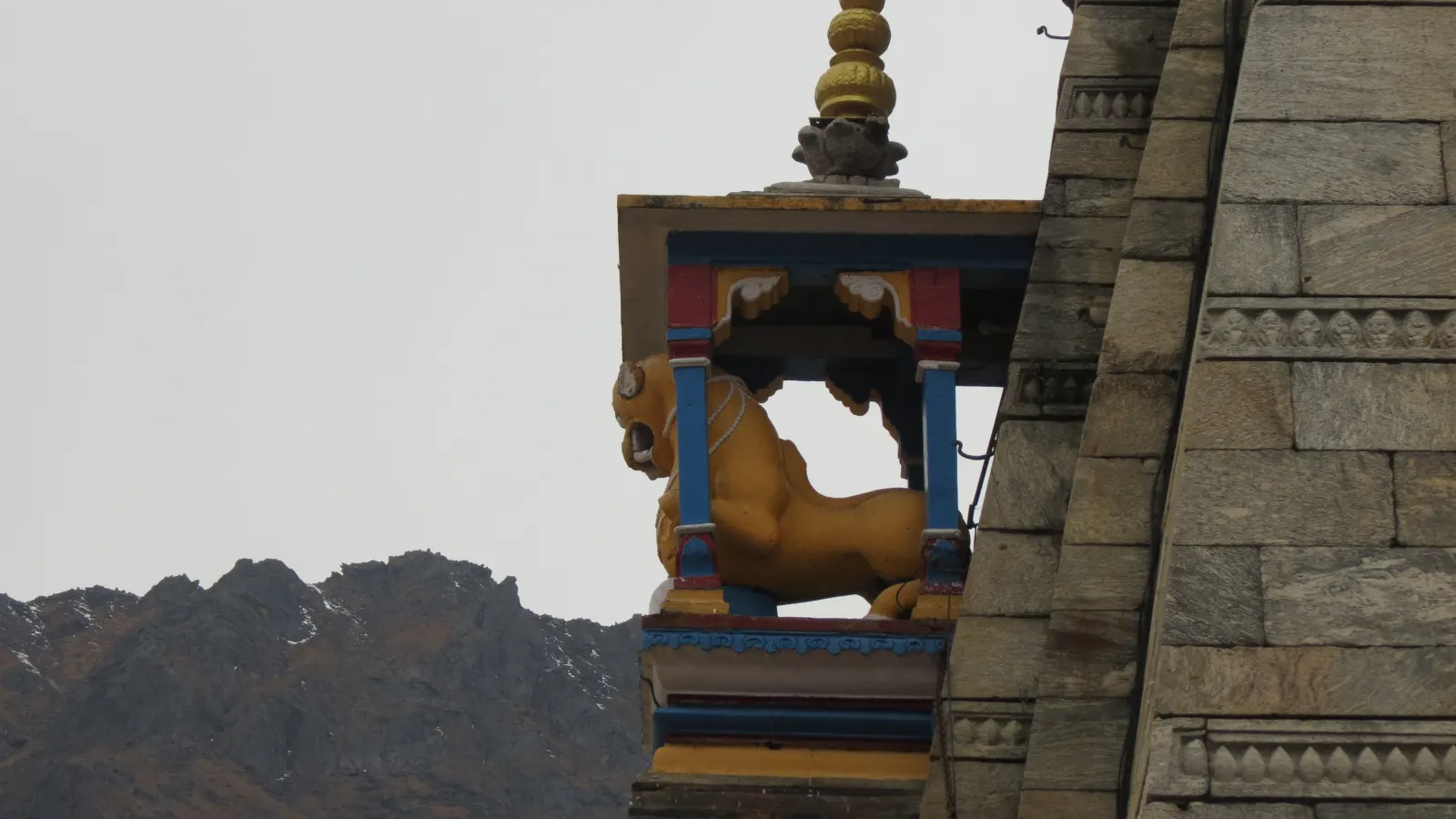
Move your attention upward and the wall is not a single flat surface. Large dressed blocks form strong horizontal courses. Narrow ornamented bands divide the height, creating rhythm without dissolving the building’s mass. Projections and recesses catch the changing Himalayan light. Weathering, past coating, ritual colour and repair make the surface a record rather than a perfectly uniform finish.
The front approach and Nandi
Nandi faces the temple as Shiva’s attendant and confirms the direction of approach. The visitor enters an existing relationship between Nandi and Shiva as steps, bells and doorway lead from open valley to enclosed mandapa.
The tower and upper roof
The rear view makes the tall sanctuary tower especially clear. Its sloping sides rise from a broad stone base toward an upper roof pavilion and finial. Horizontal carved bands continue across the vertical body, while a strong central projection marks the axis. The upper coloured timber or roof elements create a lighter visual ending above the dense masonry.
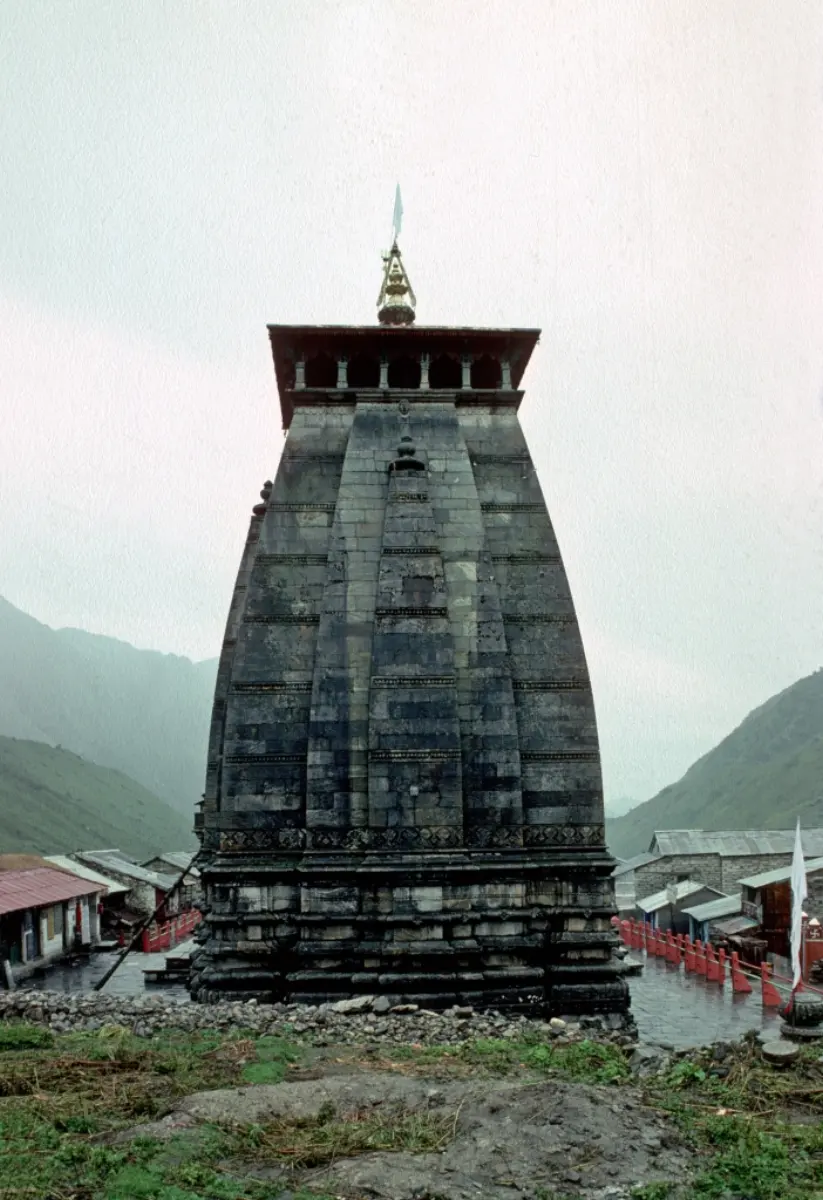 Real photograph
This historical view shows the vertical shrine meeting the older settlement: substantial stone below, a lighter roofline above, and mountains close around it. Such images help separate actual fabric from polished online reconstructions.
Inside the plan: mandapa, antarala and garbhagriha
Kedarnath’s plan is a sequence of increasing sacred concentration. Pilgrims gather in the mandapa, cross the transitional antarala and approach the garbhagriha or “womb chamber.” Moving inward changes sound, light and attention.
BKTC describes the inner walls as bearing figures of deities and scenes from mythology. ASI’s 2014 cleaning work is more specific: conservators removed oil, soot, grease and other deposits from the walls, columns and ceiling of the garbhagriha, and revealed sixteen donatory inscriptions. This reminds us that ritual creates material traces. Lamps, touch, offerings and smoke are signs of worship, yet they also require careful conservation so carvings and inscriptions remain legible.
The sanctum centres on a conical, irregular stone revered as Sadashiva and remembered as the hump of Shiva’s hidden buffalo form. Temple, rock and story are inseparable. Restricted interiors should not be replaced by invented AI scenes or unauthorised photographs; verified textual description is more honest evidence.
What stone was used, and how was Kedarnath Temple constructed?
Official descriptions refer to large, heavy, evenly cut grey stone slabs. ASI adds a material clue: stone dressers used locally available gneiss to match missing stones after 2013. It is safer to say dressed grey stone and documented gneiss repair than to label every historic block “granite” without a full survey.
The scale and regularity of the blocks imply organised quarrying, dressing, transport and setting. But the statement “no mortar was used anywhere” is widely repeated online without equivalent public documentation from BKTC or ASI. Close-set masonry can rely heavily on mass, fit and gravity, and historic Himalayan construction may use techniques not obvious at the surface. Without a published structural survey establishing every joint, an absolute claim is unnecessary.
Claims of precise tongue-and-groove interlocking, magnetic alignment or lost super-technology also need published evidence. Ancient builders possessed sophisticated practical knowledge; respecting it means studying craft and labour accurately. Snow, freeze-thaw cycles, water, seismic movement and ritual deposits affect the fabric, so endurance belongs to both construction and continuing care.
Popular claims about Kedarnath architecture: what the evidence supports
| Popular claim | Evidence-led assessment |
|---|---|
| The Pandavas built the present temple | The Pandavas belong to Kedarnath’s sacred foundation tradition. Official history distinguishes an earlier Pandava shrine from the standing temple associated with Adi Shankaracharya. |
| Adi Shankaracharya definitely constructed every part in the 8th century | BKTC strongly associates the temple with Shankaracharya, but publicly available evidence does not date every surviving structural phase to one campaign. |
| The temple is exactly 1,200 years old | This is a commonly used approximation based on the Shankaracharya tradition, not a precise scientific birthday for all masonry. |
| No mortar was used | Large close-set stone slabs are visible and officially described; an absolute no-mortar claim requires a published technical survey and should not be treated as settled here. |
| It remained buried under ice for 400 years | This popular statement needs strong glaciological and archaeological documentation. It is not necessary to explain the temple’s sacred or architectural importance. |
| Ancient engineering alone made it survive 2013 | The main temple survived amid complex flood and debris flows, with the rear boulder and local topography often discussed. ASI nevertheless documented real damage and conservation work. Single-cause explanations overstate what is known. |
| The temple was untouched after the flood | False. ASI reported damaged or missing stones, debris, roof and plinth work, interior cleaning and structural assessment. |
| The structure has never changed | BKTC says it has been continually renovated; ASI records recovery, repair, replacement and conservation. |
A claim may be spiritually meaningful without being an archaeological measurement. Pandava and Shankaracharya traditions locate Kedarnath within dharma, Shiva’s manifestation and renewed pilgrimage; neither needs invented scientific proof to remain important.
The 2013 disaster and what ASI actually conserved
In June 2013, extreme rainfall, flooding and debris devastated Kedarnath and surrounding settlements, taking many lives. The main shrine became an image of endurance, but its survival should never erase the human tragedy or become a simplistic miracle-versus-science argument.
Government conservation records are more useful than speculation. In late 2013, ASI described debris removal, replacement of a damaged wooden door, stone packing, a total-station survey and ground-penetrating radar work with the Geological Survey of India to examine possible foundation anomalies. It planned repair of the platform, matching of missing stones, interior cleaning and wooden flooring in the garbhagriha and antarala.
By July 2014, ASI reported that missing stones had been matched to the original profile and design; more than forty original architectural members had been retrieved for reuse; steps, platform and roof elements had been repaired; and wooden flooring in the mandapa had been renewed. Stone surfaces were cleaned and preserved. Roof joints were scanned. Specialists cleaned the sanctum’s walls, columns and ceiling, revealing ornament and sixteen donatory inscriptions beneath accumulated deposits.
This record changes the way we should speak about “survival.” The temple’s endurance was real, but survival did not mean absence of damage. It meant that the core structure remained recoverable and that conservators, temple authorities, engineers, craftspeople and local workers could continue its life. Architecture endured through both material strength and organised care.
Kedarnath is living heritage, not a frozen monument
In winter, ritual continuity moves to Ukhimath before returning to the high shrine. This seasonal journey shows why architecture alone cannot define Kedarnath: it is also calendar, procession, priestly lineage, memory and the repeated reopening of a route.
Living heritage must balance access and protection. Ritual creates wear, infrastructure changes the setting, and conservation may require monitoring stone, timber and water. No generation receives the temple as a finished object; each inherits responsibility.
This is why the phrase “untouched for a thousand years” is less respectful than it sounds. It erases the generations who touched, cleaned, repaired, decorated, carried and worshipped. Kedarnath’s authenticity lies not in the absence of change but in the continuity of sacred purpose through change.
What to notice respectfully when you visit
Do not block movement, touch fragile carvings, cross barriers or photograph restricted areas. Let the exterior teach you how to look.
- Pause at a distance and see how the temple sits on its plateau in relation to the valley, river direction and surrounding peaks.
- Look down at the platform and steps before looking up. Notice how horizontal mouldings lift the sacred volume from the ground.
- Follow the size and rhythm of the grey stone courses. Observe where weathering and repair make the surface less uniform.
- Stand respectfully behind the approach axis and notice how Nandi, doorway and sanctum direction align devotionally.
- Walk around only where permitted. The rear view makes the tower’s vertical form and carved bands easier to read.
- Notice the meeting of stone and colour: masonry carries mass, while painted wood, metal finials, flags and flowers announce continuing worship.
- Listen. Bells, chants, footsteps and wind are part of the architecture’s lived atmosphere even though they do not appear in photographs.
- Remember that the sanctum is a place of worship, not content production. Follow temple instructions and put darshan before documentation.
If you cannot travel, compare clearly labelled contemporary and historical photographs. Ask what changed, what remained and what the frame leaves out. AI reconstructions may be art, but they cannot answer a historical question.
Mandir Vedas offers an independent devotional service for families who wish to include submitted names and gotra details in a Kedarnath Archana and receive temple-premises video proof. Mandir Vedas is not the Shri Badarinath Kedarnath Temple Committee and does not claim official temple-administration affiliation. For official temple pujas, donations, opening dates and rules, use BKTC’s own channels.
Kedarnath’s stone does not answer every question. It does something more valuable: it teaches us to ask better ones. Who carried these blocks? Which surfaces belong to which repair? How did worship continue when snow closed the route? What does it mean for a structure to survive a disaster but still require care? Why do generations keep returning to this particular meeting of rock, river, mountain and Shiva?
The temple’s greatness does not depend on exaggeration. It stands in the disciplined weight of its masonry, the inward movement of its plan, the continuity of its rituals and the humility demanded by what remains unknown. To look carefully is already a form of respect. The stone is ancient; the worship is present; and the work of carrying both forward belongs to the living.
Frequently asked questions
Who built Kedarnath Temple?+
Temple tradition remembers an earlier shrine established by the Pandavas and associates the standing temple with Jagadguru Adi Shankaracharya, commonly placed in the eighth century. The precise builders and dates of every surviving structural phase are not securely established in one publicly available archaeological record, and the temple has been renovated repeatedly.
How old is Kedarnath Temple?+
BKTC describes Kedarnath as over a thousand years old and links it to the eighth-century Shankaracharya tradition. That is a respected institutional and sacred chronology, but it should not be treated as an exact scientific date for every stone in the present structure.
What style of architecture is Kedarnath Temple?+
Kedarnath is a high-Himalayan stone Shiva temple with a raised rectangular platform, assembly hall, transitional chamber, sanctum and tall tower. Its visual character comes from massive dressed stone courses, horizontal carved bands, a concentrated inward plan and the relationship between the building and its mountain setting.
What stone is Kedarnath Temple made from?+
Official descriptions call the masonry massive, evenly cut grey stone slabs. During post-2013 conservation, ASI specifically recorded using locally available gneiss to match missing stones. It is safer not to label every historic block granite without a complete published material survey.
Was Kedarnath Temple built without mortar?+
The visible structure uses large, closely fitted stone slabs, but the absolute claim that no mortar or binding material exists anywhere is widely repeated without equivalent public technical documentation. A full structural survey would be needed to establish every joint and construction phase.
Why did Kedarnath Temple survive the 2013 flood?+
Its substantial stone construction, platform, location, flow paths and the large boulder behind the shrine are all discussed. The event was physically complex, and a single proven explanation should be avoided. The main shrine survived but was not untouched; ASI documented damage, surveys, debris removal and extensive conservation.
What are the main parts inside Kedarnath Temple?+
The main spatial sequence comprises the mandapa or assembly hall, the antarala or transition and the garbhagriha or sanctum. The sanctum contains the irregular conical rock worshipped as Shiva in Sadashiva form and associated in Panch Kedar tradition with the buffalo’s hump.
Are there inscriptions in Kedarnath Temple?+
Yes. BKTC mentions inscriptions on the temple steps, while ASI reported revealing sixteen donatory inscriptions during interior cleaning after the 2013 disaster. Their presence supports a history of continuing patronage, although the brief conservation release does not provide a full reading and date for each.
Did the temple remain under ice for 400 years?+
That claim is popular online, but it requires strong, directly cited glaciological and archaeological evidence. It should not be repeated as settled fact merely because surface weathering is visible. Kedarnath’s importance does not depend on this claim.
Can visitors photograph the inside of Kedarnath Temple?+
Photography rules may change and sensitive areas can be restricted. Follow current BKTC and on-site instructions, never obstruct worship, and do not assume that a photograph circulating online was authorised. Exterior architectural observation and properly licensed documentary images are safer for study.
Sources and further reading
Travel requirements and temple schedules can change. These official sources were checked while preparing this guide.
- Shri Badarinath Kedarnath Temple Committee — official Kedarnath history and architecture
- Uttarakhand Tourism — official Kedarnath destination overview
- Incredible India — Government of India Kedarnath overview
- Press Information Bureau / Ministry of Culture — Conservation Work at Kedarnath by Archaeological Survey of India, 4 July 2014
- Press Information Bureau — ASI conservation plan after the Kedarnath disaster, November 2013
- Cornell University Library — Kedarnath Temple historic architectural photograph and catalogue record
- Luke Whitmore — Mountain, Water, Rock, God: Understanding Kedarnath in the Twenty-First Century